Journalism was the input. Gravity was the product.

Journalism was the input. Gravity was the product.
For most of the last century the local newspaper was a city’s binding agent. It gave residents a common set of things to know and talk about, and in doing so it held otherwise unrelated parts of a city in contact with one another. That function has largely disappeared, and what replaced it is national by design.
Cityverse is a way to rebind a city, described in three papers: what is built to gather a city’s attention again, why people come back to it every day, and how the gathering pays for itself. It is being built first in St. Petersburg, Florida.
What a newspaper actually sold
A city of two hundred thousand people once shared one object every morning. The newspaper told a mechanic and a bank president the same forty facts before either of them got to work. It printed the school board agenda and the high school box scores and the obituaries and the zoning notices, and gave a quarter million strangers a common set of building blocks for constructing their days.
An advertiser buying a half page in 1985 was buying one thing: the fact that most of the city would read the same object on the same morning. The paper spent money producing something a town would gather around, then sold access to the gathering. When the business moved online, publishers behaved as though the journalism had been the product. They put it behind paywalls and cut the calendar, the classifieds, the club notices and the obituaries, which were among the strongest gravity the paper had.
Gravity is a city’s attention, assembled in one place, in a form that local parties can act on. A resident who spends ninety minutes a day inside a national feed is engaged and unreachable at the same time.
That gathered attention is the asset. It costs money to build, and there are known ways to turn it into revenue. The three papers take it in order: how it is built, why people keep coming back to it, and what it is worth.
From Engineering the Commons, chapters one and two.
How gravity is built now
The demand a newspaper served never went away. People still want to know what is happening in the place they live, and they still want the people around them to know it too. What the newspaper lost was the contest for attention. The national platforms arrived with a better experience, faster, free and endless, and their gravity pulled a city’s attention out of the city. A resident now spends the evening hour inside a feed that knows nothing about where they live, and the platforms have no reason to change that. They gather attention at national scale and sell it at national scale, and a city is only a location field to them.
That is the opening. The tools that built the platforms are now available to anyone, so a city’s gravity can be rebuilt with them, and rebuilt out of many small pieces instead of one printed edition: a team’s schedule, a museum’s calendar, a neighborhood’s classifieds, a council vote reported the same night. Each piece is local by construction, which is the one thing a national platform cannot supply, and each can be adjusted on its own. Cityverse competes for the same evening hour with the same machinery, and wins it back by binding it to the place a person actually lives.
Every piece is a value chain, and the paper uses a high school’s sports teams to show one running end to end. Cityverse gives the school free software for running its teams: schedules, statistics, plays. The school cannot sell any of that, so it would never build the software itself. The scores the coaches enter in real time become reporting, the reporting goes out through Cityverse as content, and the parents who follow it are an audience that local businesses will pay to reach. The school produces something it cannot sell, Cityverse changes its form, and the advertiser at the end pays for the whole chain. The software earns nothing on its own line; it is paid for by attention that pays out on lines it never touches. This is why the papers insist that no single feature be judged on its own ledger. The cost lands on the feature and the revenue lands on the network.
A few rules follow from this. Only the first link in a chain is bought: the school’s software costs Cityverse money, and everything downstream of it comes free. A link can live inside someone else’s institution, a school, a museum, a league, as long as the arrangement is written so that it survives the people who made it. And because the point is the gathering, nothing is charged at the door. Reading is open to anyone in the world, taking part requires living in the city, and ordinary pricing applies once someone is inside.
Two more rules govern how the commons is run. Moderation applies to how people treat each other, and a person’s position is left alone. And each city’s record, the data and the history its residents create, stays in that city’s hands, with the city deciding what, if anything, leaves.
From Engineering the Commons, chapters three to thirteen.
Why people come back
A shared layer for a city is only worth building if people come back to it every day, so the second paper is about what brings them back. It asks the question a reader is entitled to ask of any design that admits it is engineering a habit: what separates a version that serves the person from one that consumes them?
The machinery is the same in both cases. The cue that makes a person pick up the phone, the small reward when they open it, the story that keeps them there: these run the national platforms a city lost its attention to, and no platform holds attention without them. What differs is what the machinery is aimed at, and who keeps what it produces.
Aimed at what a person watches, it extracts. Aimed at what a person does, it serves.
Watching is what the national feed sells: an argument between strangers, a stranger’s kitchen renovation, ninety seconds of anger at a man you will never meet. Doing is what a city has and a national platform cannot supply. It has two halves, and the paper gives them equal weight: what a person does in the city, at the school board meeting or in the stands, and what a person does on Cityverse, in the rooms and tools built around the things they already care about. The feed’s cues open drama, because drama is the only story a platform with no newsroom can produce on schedule. Cityverse produces the news, the tools and the rooms, so its cues open things that actually happened, close to home. The rewards that hold up over years are autonomy, competence and belonging, and a city is one of the few places that can supply all three.
From Engineering Attention.
How it pays for itself
The third paper puts numbers on the first two. Gravity is an asset in the ordinary sense: it costs money to build, and it turns into cash in known ways. Whether a company can run a civic commons at a profit comes down to whether the second figure clears the first.
The cost has two parts, and they behave differently over time. The software is built once and then deployed to each new city for almost nothing. The local organization, the newsroom and the small team that runs the city, has to be built again in every city, and its cost never spreads to the others. The first year of that organization is the expensive part, before the city earns much back. Cityverse covers it by selling a minority stake in each city’s LLC to people who live there. That keeps expansion off the parent company’s balance sheet, and it means every city opens with local backers who have a reason to see it take root.
The revenue comes from the things people use: the classifieds, the galleries, the fan bars, the advertising a business buys. None of these is worth much empty. A classifieds section nobody reads sells nothing, and a fan bar with no fans is a dead page. What makes each of them valuable is the attention already gathered around it, which is why the paper prices the attention around each utility and treats the utility as its container. The revenue lines switch on in order as the city grows, each becoming worth running once enough people are there, while the cost of the organization holds roughly flat. A city breaks even on a small share of its population, and the network turns profitable as cities are added.
A few rules protect the asset while it is being sold. Advertising is sold openly, and paid placement never buys its way into the organic Flow. Cash buys everything on the platform; the currency layered on top is one-way and closed, so that it never becomes a regulated exchange. Data is traded with partners and never sold. And nothing a resident can buy is the standing a resident has to earn.
From Engineering Value. The paper works its arithmetic on a stylized city of a quarter million people. The rules above hold for any city; the figures stay in the paper.
Cityverse is the design, built
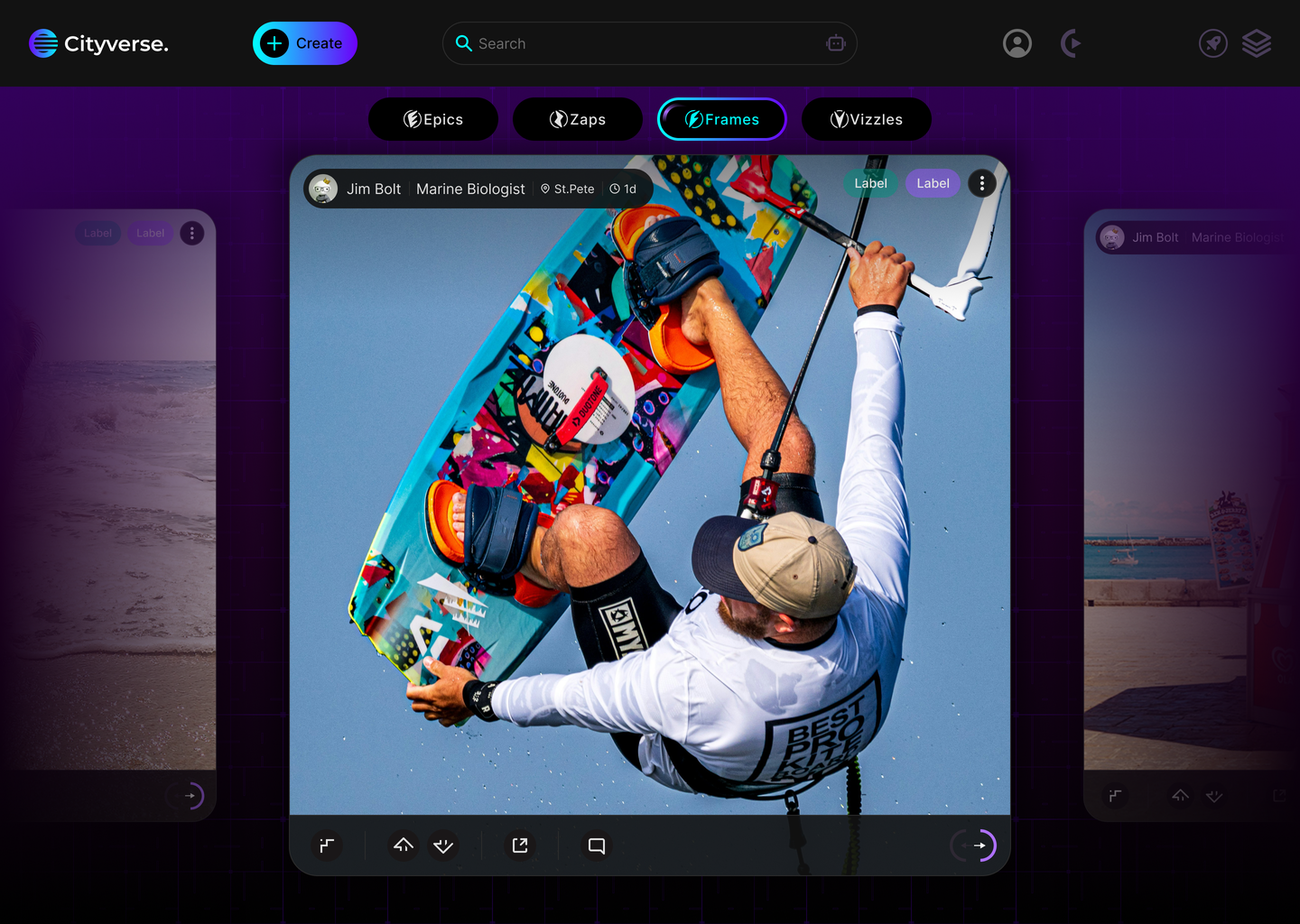
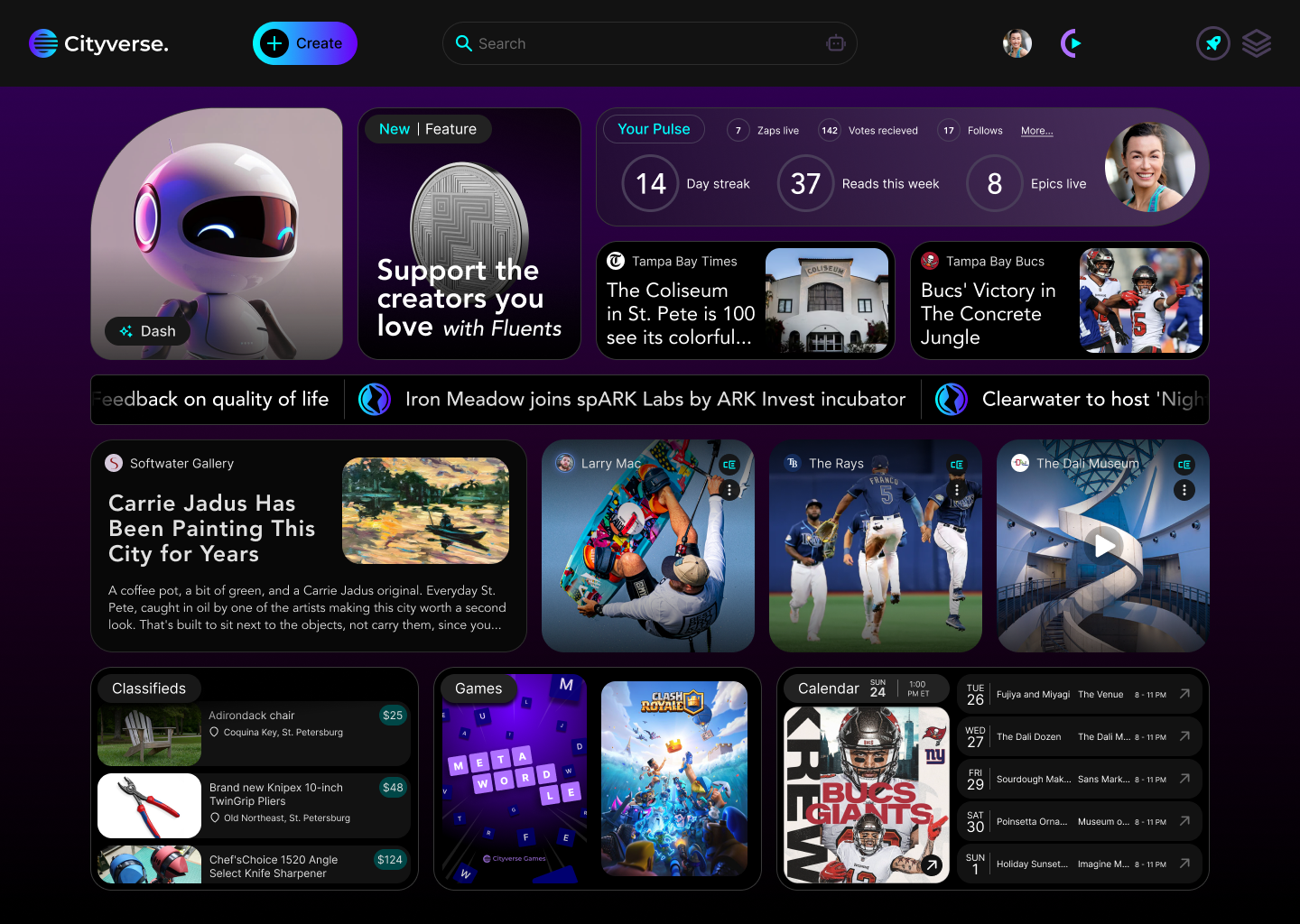
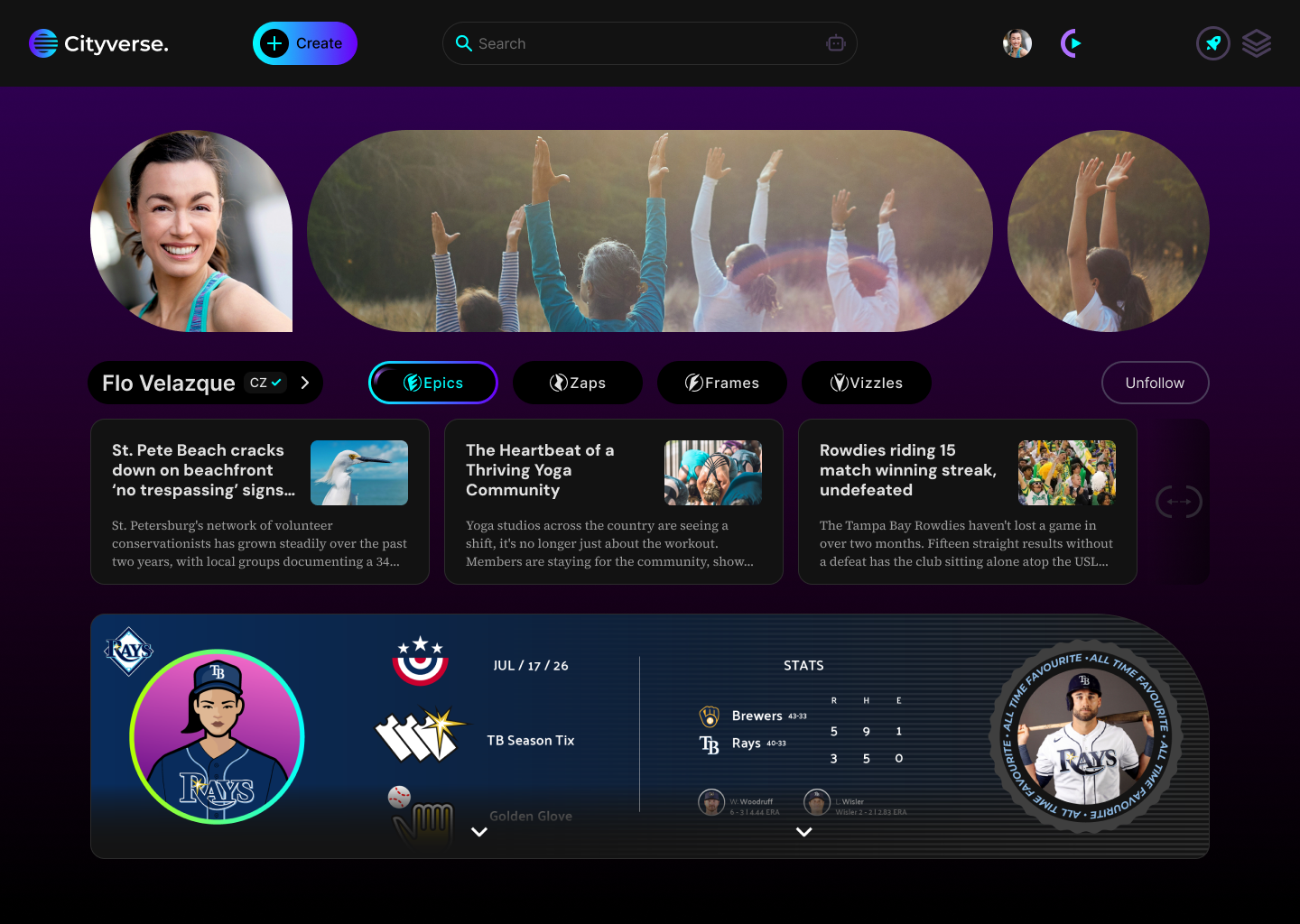
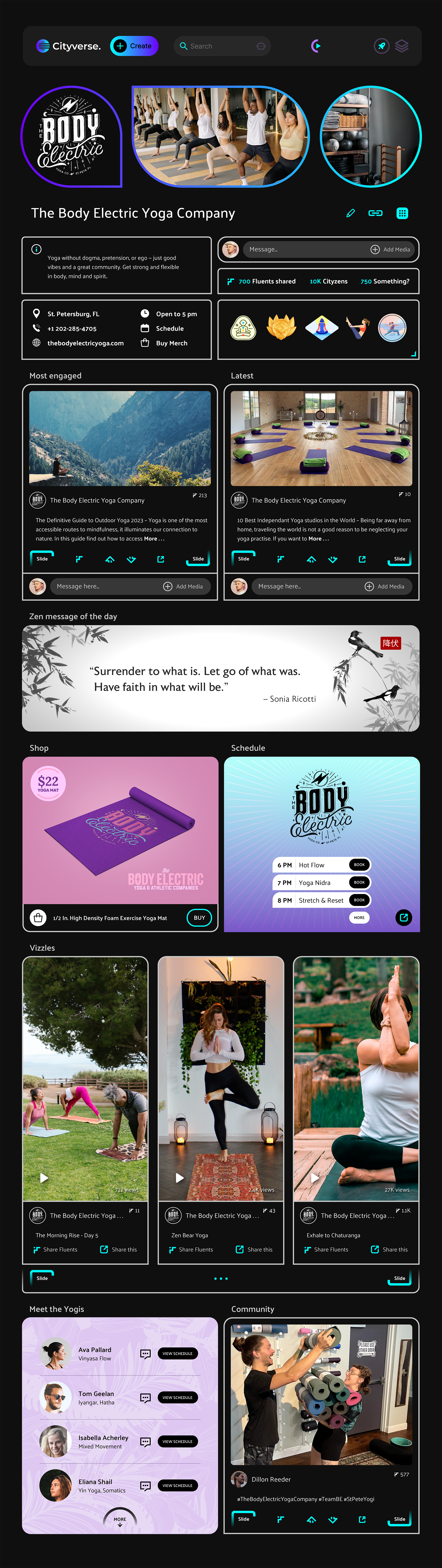
Building a city’s attention deliberately produces civic goods along the way: local coverage, a market for local work, tools that institutions could not afford alone, and a place where residents meet as neighbors. The figures below show the product in four layers. Four surfaces every resident uses; two ways a city is kind to itself in public; three examples of tools that live inside other people’s buildings; and three of the features that pull attention home.
Figures 1 to 4 are the working designs for St. Petersburg. Figures 5 to 12 are illustrations of the idea, drawn in the same system.
The surfaces
Four places a resident is, in a day. Each is a piece of the one object a city used to share every morning, rebuilt so it can be assembled from many hands instead of one newsroom.
Community, and positive drama
National feeds run on conflict because conflict travels. A city’s feed can run on something else. Two features built so that the most shareable thing in town is a kindness.
Tools in the chain
Costs land on the feature and revenue lands on the network. So the network can give away software an institution could not afford alone, and a league, a gallery or a realtor becomes a link that brings its own people with it. Three examples.
What pulls attention home
The classifieds, the calendar and the personals were the strongest gravity a newspaper had, and the first things publishers cut. Rebuilt for a membership of verified residents, they are the reasons a person opens the city every day.
Every city is its own biome
A frog in Madagascar and a frog in Peru are both frogs. One can kill you; one may hold a compound that cures something. Nothing in the general category tells you which, because the answer is a property of the biome. Two American cities of the same size will answer the same zoning proposal in completely different ways, for reasons that live in local history and a hundred fights that happened before anyone in the room arrived.
So each city runs its own Cityverse. Its record is built from its own data and stays its own. Reading is open to the world; participating requires living there.
Built on the St. Pete Catalyst’s audience and newsroom.
How a second city gets built is chapter fifteen, the chain factory.
Operators
Cityverse is built by the team behind the St. Pete Catalyst, an independent local news operation in St. Petersburg, Florida. The Engineering series describes a trade the Catalyst has been running for years. Cityverse is that trade built deliberately, with the pieces a printing press never had.
Joe Hamilton is the founder of Cityverse and the Catalyst, and the author of the Engineering series.
The Engineering series
Each paper stands on its own and all three describe one system. Free to download, share and quote with attribution.
Engineering the Commons
A Design for Rebinding American Cities
The founding paper, in fifteen chapters: what a newspaper actually sold, how a value chain runs end to end, and what Cityverse assembles to gather a city’s attention again.
Engineering Attention
A Design for Holding a City’s Attention Without Taking It
The behavioral lens, in twelve chapters: the machinery of habit, what it is aimed at, and who keeps what it produces.
Engineering Value
A Design for How a Civic Commons Pays for Itself
The financial lens, in twelve chapters: the two kinds of cost, how a city’s first year is funded, and how instruments that each run at a loss are operated together at a profit.
Writing about local news, civic technology or the attention economy?
The papers are free to quote with attribution. Joe Hamilton is available for interviews, and the Catalyst newsroom can speak to what the trade looks like on the ground.
Cityverse is raising to build the first cities.
Accredited investors and strategic partners can request the deck and the data room. Terms are identical across the round.